Saturday, July 6, 2013

ASoNAudiophiles - June 2013


ASoN Meeting –  June 2

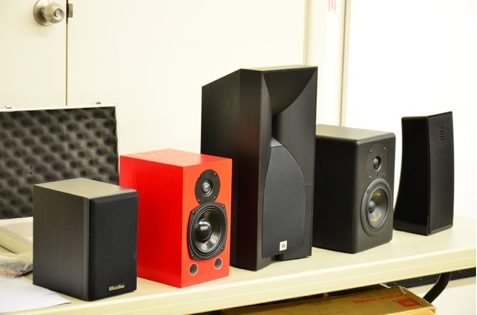
Small Speaker Shootout

Proving that size doesn’t matter?


Introduction:

At the June meeting we decided to put some small speakers to the test. Nothing over 5” woofer, and all under $1,000.


Equipment:

Source was a CAL California Audio Labs CD player – one of a few to still use a parallel DAC (Philips chip) rather than the more common delta-sigma DAC’s prevalent today.

Rather than use the internal volume controls, a Lightspeed attenuator (passive pre-amp – I hate that term) was used.

Amplification was courtesy of an Elson Silva designed and built Cymer tube amplifier, putting out about 90Watts per channel.

Listening:

The speakers were listened to in 2 rounds, of 3 tracks each; in the second round, we reversed the order, to try and rule out the effect of sequence, and to help comparative scoring.

Speakers tested:

Round 1: MartinLogan Motion 4, JBL Studio 530, Xavian Bonbonus, Silverline Minuet, Grover Notting CR-11

Round 2: the reverse order

Tracks included:

Dave’s Story – “Like a Rock”
Damian Rice – featring acoustic guitar, violin, female voice
Tommy Emmanual – “Amanda’s Room” – electric guitar, sax
Hilary Halin – classical violin

My overall impressions ( sitting front centre, and noting that with small speakers they may have struggled a bit depending where you were sitting – although in this respect they were often surprisingly good).

Martin Logans – consistently good – nice clean treble, surprising amount of clean fast bass
JBL’s – sounded boxy, and smewhat disjointed, as if the horn top was not well integrated with the woofer (via the crossover)
Xavian – somewhat restrained treble – even somewhat veiled
Silverline – sounded like a much bigger speaker, surprising bass, treble perhaps a bit hard and sibilant, but a lot of speaker for the size and money
Grover Notting – lacked body, almost as if there was a “hole” in the mid-range – however, these are not designed to be used on stands, but on the bridge of a mixing console in a studio. As the “Cross Reference” name implies, it is intended to allow mixing engineers to get an idea of how it sounds on “typical” home equipment.

Having said all that, expecting such small speakers to work at all satisfactorily in such a large room, which requires about ten times the power we would use at home, is a tough ask – to that end, none could be said to have failed.


Conclusion:

 And the winner is (the envelope, please)….

Results – total score:

Round 1: ML 284, JBL 249, Xavian 234, Silverline 287, GN 239
Round 2: ML 262, JBL 242, Xavian 239, Silverline 272, GN 208
Totals---: ML 546, JBL 491, Xavian 473, Silverline 559, GN 447

Rankings:

1. Silverline
2. MartinLogan
3. JBL
4. Xavian
5. Grover Notting

A big Thank You to Richard Wong, George Stanscheff, Edgar Kramer, Elson Silva and all who helped organise this meeting.


Morris Swift

Thursday, April 25, 2013

ASoNAudiophiles - February 2013

ASoN Meeting –  February 3, 2013

Ultra Low Distortion Amplifier – Mark 3

An Audiophile-quality DIY Amplifier Project from Silicon Chip Magazine


Introduction:

As a kid, I was interested in all things electrical, mechanical and then electronic. Yes, folks, I was a kid once – now, I’m a big kid.

(Contrary to what my offspring think, I did not hatch from an egg at age 40 – they think that’s why I just don’t understand their generation.)

Without the benefits (???!!!) of personal computers and the internet, one of my main sources of electronics information and education was the Australian magazine Electronics Australia. The high point of every month was when a new issue appeared at the newsagent. (No, I wasn’t a nerd nor a geek – they hadn’t been invented yet.)

Each issue contained lots of interesting articles, and best of all, projects to build, pocketmoney permitting. Parts were expensive then!

One of the main writers and designers was a chap called Leo Simpson. And one of my first “serious” amplifier products was the “3 plus 3” – a solid state amplifier with a massive 3 watts per channel – designed by Leo.

I also built a model train controller, power supplies, and a signal injector probe using the very first integrated circuit, with – count them – 6 transistors! Or was it 4?

Turn the clock forward 50 years, and Leo Simpson is now publisher and editor of Silicon Chip magazine. Their latest amplifier is 200W per channel, designed by talented staffmember Nicholas Vinen, featuring less than 0.0006% harmonic distortion, and claimed to be the lowest distortion amplifier design ever published in such a magazine (if not ever). In fact, this distortion is so low that it is almost impossible to measure, as it rivals the inherent distortion in the test instruments themselves. And it is also almost impossible to separate the distortion from the noise, so in fact it’s probably even lower.

So, how does this translate to actual perception, to actual listening?

I contacted Silicon Chip and asked if we could borrow the amplifier, and also if Nicholas or Leo would like to do a presentation.

I was thrilled, and felt quite honoured, when Leo agreed.


ULD3 amplifier Specifications:

Officially, the ULD3 is a power amplifier, but it is also used as part of an integrated amplifier design, featuring the Silicon Chip Audiophile Pre-amp. It was the integrated amplifier that we had for the meeting.


Output Power: 200 watts RMS into 4Ω; 135 watts RMS into 8Ω
Frequency response: +0, -0.3dB (8Ω); +0, -1.0dB (4Ω) – 10Hz-20kHz)

Rated Harmonic Distortion (8Ω): <0.004% 20Hz-20kHz, typically 0.0006%
Rated Harmonic Distortion (4Ω): <0.007% 20Hz-20kHz, typically 0.0006%
Signal-to-Noise Ratio: 123dB unweighted with respect to 135W into 8Ω (22Hz to 22kHz)
Damping Factor: ~180 with respect to 8Ω at 1kHz & below
Stability: unconditionally stable with any nominal speaker load ≥ 4Ω

Equipment:

For comparison, ASoN member John Sawley provided his Odyssey Stratos power amplifier, rated at 150W per channel.

Speakers were the club’s KEF Q900 floorstanders.

Sources were:

  • CAL CD player, with its Philips parallel DAC, still favoured by many over the current generation of Delta-Sigma DAC’s.
  • Oppo 95 upgraded by Joe Rasmussen.
  • Sony DVD player DVP-NS300 (vintage 2000) feeding my Behringer SRC2496 DAC/sample rate converter (a very useful box, by the way – ask Google) – used at the start, as a backup, as the CAL was late arriving, and the modded Oppo takes up to half an hour for the clock to stabilize.


Listening and Music:


1)    Female opera singer Natalie Desai – Composer Sans Saens – La Rose
EMI Vocalisers - Oppo

2)    Male opera – The Mikado highlights – A Wondering Minstrel I

We used the Sony, as the Oppo would not play this disc properly, and the CAL had not yet arrived.

The mids were edgy and hard, which was put down to a bad recording, and the fact that the KEF’s are very revealing in this range. Some felt the KEF’s were ringing, but I doubt it. Although I remember previous meetings at Haberfield where the highs through the KEF’s would set your teeth on edge, I put this down to interaction between the KEF’s wide dispersion (directional characteristics) and the room. I have used them extensively at home, and while they are “a touch bright”, that is all.

3)    Opera – male and female – Mozart K441 - “Das Bandel”
Philips sampler – Best of the Best


Leo Simpson’s Presentation:

And now, here comes the moment you’ve all been waiting for…. (and there it goes).

Leo Simpson began his presentation, which was a rare insight into amplifier development over the years, and some “tricks and treats” that he was prepared to share with us. I can tell you that much of this valuable information is not to be found in textbooks and engineering papers, and is far from obvious.

Leo spoke about bipolar transistors versus FETs – he felt the former were superior (for power amplifier output stages), a sentiment I have heard from most leading solid state designers. He also talked about distortion mechanisms in Class B push-pull amplifiers, and the role the power supply – and layout! -  can play, being just as important as crossover distortion (which occurs as the signal swings through zero, and one of the output transistors “hands over” to the other).

Leo pointed out that at this level of performance, even the inductance of the output (emitter) resistors is a significant factor, and how they were able to compensate for it.

Finally, he touched on the preamp design, which uses the LM833 opamp. He claimed that after substantial evaluation and testing of many devices, this was their choice, giving best performance versus cost (“bang for buck”).

I should add that although this is a DIY amp from a hobbyist magazine, it employs some of the latest research in its design. Nick has also painstakingly modeled the circuits using simulation software such as SPiCe, to optimize the design and check for sensitivity to component variations. And then the prototypes(s) were measured using an Audio Precision test set – the system of choice in many top audio labs.

(Simulation software such as SPiCe allows a circuit to be entered into a computer, and its behaviour to be modeled and tested in great detail, and very accurately, without having to pick up a soldering iron! The software provides a suite of virtual test instruments, such as oscilloscopes, multimeters, spectrum analysers, and so on. Such programs can even factor in the effects of layout, stray coupling between components, the material from which the circuit board is made, and more. Thousands of man-hours – sorry, person-hours – can be saved, and measurements can be performed that are almost impossible on the bench e.g inside an integrated circuit. What’s more, these test instruments don’t load or disturb the circuit under test, as real instruments do.)

Unfortunately, at this point, Leo had to leave, so yours truly became DJ, playing some more music, and then swapping to the Odyssey.

More Music and Comparison:

Because the Odyssey is a power amp only, we used a Lightspeed attenuator as volume control.

Tracks played were:

1)    Walt Disney’s Lion King – a selection of tracks featuring some outstanding male and female vocal, IMNSHO (in my not so humble opinion); and the fight scene, with very loud and dynamic drumming, brass and percussion.
2)    Stevie Ray Vaughan – Riviera – a delicate electric guitar track
3)    K D Laing – Hallelujah – beautiful female voice, nicely recorded piano
4)    Carly Simon – In My Dreams – as above, but Carly’s voice readily reveals any tendency toward sibilance.
5)    Tommy Emmanual with
6)    Josh Groban – When It Rained – one of the best and most versatile male voices, with piano and orchestra

Of course, I committed one of the most frequent and cardinal sins – I did not match the volume settings in the comparison.  Frankly, the logistics of swapping systems, powering up and down, CD’s with very different recording levels, and limited time, made this extremely difficult.  

But why is this such a problem?

The issue is that a change in volume changes perceived quality, and tonal balance.
For example, at lower levels, we are more sensitive to mid-range frequencies, and bass and treble become much softer relative to these. Conversely, as we increase volume, bass and treble become more prominent.

Early amplifiers – typically those that had tone controls -  usually had a loudness switch. In the more basic designs, these provided additional, fixed boost to treble and bass. In the better amplifiers, they were linked to a control on the back of the volume control, such that when the volume was turned down, they provided progressively more boost to treble and bass.

This listening characteristic is described in the so-called Fletcher-Munson curves, which show the ear’s varying frequency response at different levels.

Summing up, a volume change of even one decibel or less – barely perceptible – can be heard as a significant change in tonal quality or balance.

Usually the louder amplifier or speaker will be preferred.

In this comparison, I didn’t think that there was an outright winner, but I would describe the Odyssey as having “more weight”. Bass seemed more extended and powerful.

But the amp’s owner, while agreeing, added “there’s really not much in it”, and then stated that he would seriously like to build himself a ULD3! Clearly, he was very familiar with the much-more-expensive (but still considered to offer great value) Odyssey, so I consider this high praise indeed.

The difference may have been due to:
  • volume settings – as above;
  • the use of the Lightspeed attenuator with the Odyssey may have made it more dependent on the characteristics of the interconnects (cables), due to the higher impedances;
  • we heard the Odyssey after the ULD3, and second listening tests exhibit a statistical preference;
  • and, of course, placebo effect - bigger amps (seem to) sound bigger.

(Of course, there’s heaps to discuss/debate here.)


Conclusion:

No matter how you look at it, for a kit costing just $750, this is one hell of an amplifier! You could spend ten times that on a finished product that might be quite inferior. Sure, you’ll have to put in a lot of (hopefully enjoyable) hours building it – provided you have the skills - but the result is worth it on many levels. Perhaps we might run a DIY SIG to help interested members if there is demand.


A very special thankyou (and congratulations) to Leo Simpson and Nicholas Vinen! Now, when can we have the DAC you showed me?????


Morris Swift


Saturday, June 9, 2012

ASoNAudiophiles - May 2012


ASoN Meeting – May 6, 2012

Acoustic 3D – 3 dimensional acoustic hologram speakers

Introduction:

 At the May meeting, we got an early look at radical new loudspeakers from Australian company Acoustic 3D. Although when I say “new”, they have been over 20 years in development, and incorporate innovative thinking and application of a field of mathematics known as fractals. Think chaos theory, clouds, snowflakes, and the famous Mandelbrot set. (I’ll leave it to interested readers to google.)

These speakers promise to virtually eliminate the effects of listening room acoustics, including echo – previously considered difficult if not impossible.  The goal is to “make every spot a sweet spot” i.e. all listeners should hear the same thing, regardless of location, and of course, to provide an accurate 3 dimensional image.

Inventor, mathematician and acoustician Joe Hayes, together with esteemed loudspeaker designer Brad Serhan, presented a small speaker system, currently on sale, known as the Emergence 2.1,  and an early prototype of a larger speaker known as the 7 2 or 7 squared.

The first speakers are based on fractal dispersion algorithm lenses which create a 3D sonic field. This lens, which sits above the upward-facing driver, at about 45 degrees, looks like a series of channels or slots machined into a short length of aluminium or plastic (presumably), and acts to disperse the sound waves in accordance with the mathematical theory stated above.

The latter speakers use an array of 49 x 2” drivers arranged in a square, hence the name. They also have a tweeter array of 49 dome tweeters similarly arranged, although being a prototype these were not yet fitted. Seven channels of amplification and digital signal processing are used to create the required sound field, again according to the above theory, as well as allowing the sound to be tailored and compensate to an extent for some of the driver limitations.


Equipment:

As the Emergence 2.1 are not designed for a room as large as the main listening room, these were set up in the foyer.

Closing my eyes, I could imagine a much larger loudspeaker, and the sound did indeed fill the room, with impressive image size and surprising depth.

In the main room, we had the 7 2’s with source from a computer.

Brad was using feedback from listeners to tune the DSP (digital signal processors) in the 7 2’s, and made considerable improvements in a surprising short time – aah! the power of DSP!

The overall opinion was that these speakers sounded “ a bit PA (public address) “, and in my words “lacked the finesse of what audiophiles are used to”. But it must be remembered that these were prototypes, and did not have the tweeters fitted, so the midrange/woofers had a difficult job to do.

Some felt this was due to the use of DSP and Class-D (switching) amplifiers, but I doubt it. Despite popular opinion (not based on fact) to the contrary, some class-D amplifiers in my experience, sound amazingly clean and detailed. They don’t suffer from crossover distortion, for starters, although they do have to overcome other issues.


Conclusion:

While there are some loudspeakers in commercial use using arrays and DSP to “steer” the sound without having to physically move the loudspeaker, Acoustic 3D are taking the technology to new heights, and attempting to accomplish much more: the removal of the listening room!


(Steering is accomplished by applying a time delay to various drivers – this has the same effect as moving them. For example, as sound travels at 345 metres per second, if we delay the sound by one thousandth of a second in the DSP, it’s as if we moved that speaker back by 345mm.

This idea was originally used with radar antenna arrays in the 1940’s! Although then they were dealing with radio waves travelling at the speed of light, so an extra metre of antenna feed cable had the same effect as moving the antenna a metre (approx).)


The Emergence 2.1, which use a sound lens rather than DSP, is especially ingenious – and effective.


I believe that these speakers are just the forerunners of some very exciting things to come, using DSP, and that they help cement the place of DSP in high end audio.


Watch this space !!!


Many thanks to Joe Hayes and Brad Serhan for a most interesting and exciting session.


Saturday, May 12, 2012

ASoNAudiophiles - March 2012


<h2>ASoN Meeting - March 2012</h2>


Introduction:

I was really looking forward to this one, as I had heard a system comprising equipment from Acoustic Zen Technologies, Rogue Audio, and North Star Design a while ago, and rated it most highly.

This system was a step above in terms of the specific models.

Equipment:

Speakers: Acoustic Zen Technologies – 3 way – horn loaded ribbon tweeter, 2 x midrange with underhung voicecall in MTM (D’Appolito) configuration; 2 x base drivers in transmission line.

Amplification: Rogue Audio (tube) M180 Monoblocks featuring KT90 output tubes in ultralinear or triode mode; Athena reference preamp.

Unusually, you can switch modes “on the fly” – no need to power down.

Source: North Star Design USB-DAC32 “32 bit” DAC, sourced from laptop and M192 CD transport with I2S interconnect (rather than SPDIF).

Cables: Acoustic Zen Technologies and HDiamond

DAC to preamp - silver; remaining copper; power cables – regular economy IEC


Playlist and Impressions:


( I was seated front row centre.)

Ultralinear mode; CD transport

1) Carol Kidd – Dreamsville

The double bass and Carol’s voice were very detailed and natural – realistic and convincing; there was a touch of midrange “glare” when other instruments came in. As usual “blame it on the room”.

2) Orchestral – brass intro.

Clean, fast bass extension; brass had the right amount of “bite” without becoming harsh

3) Alan Taylor – Old Friends, New Roads

Good clarity; guitar perhaps more convincing than the voice

4) Antiphone Blues – Arne, Domnerus

Sax and pipe organ – lots of reverb in the recording, difficult to judge

5) Jennifer Warnes – Bird on a Wire

Good example of the speaker’s “speed”. I don’t really like that term, but transients were very clean and this track highlighted the low distortion of underhung voice coils and transmission line bass loading

6) Scheherezade – London Philharmonic Orchestra – Jose Serebrier

Here we switched between ultralinear and triode modes.

The solo violin was very clear. Triode mode sounded warmer, and by comparison, ultralinear now sounded a bit lean and clinical (but by no means “bad”).
Ultralinear seemed to give greater clarity to the strings of stringed instruments; triode gave a greater sense of the actual body of the instrument i.e. more depth, weight.

From here on, the vote was to stay with triode mode.

7) Allen Smith Quartet – Estate – Live jazz recording featuring trumpet and piano

Piano was realistic, with great presence and the right sense of size.
Trumpet was also realistic and “there”.

8) Naim demo disc – Thea Gilmore – rock

Awful recording, sounding very “cluttered”. Difficult to separate vocals, instruments.

9) Pink Panther Theme

Great detail, resolution, dynamics. Lovely percussive attack on Hammond organ.

One of the best tracks so far.

10) African – male voices

Good ability to distinguish and separate the voices.


After the break, we changed source to high resolution internet downloads on PC.

11) Jazz trio – featuring piano.

Natural, drums very dynamic and detailed, perhaps a touch of ringing on the piano at times, soundstage a bit “dual mono” at times.

12) Female vocal, baritone sax, drums

Very realistic, one of the best tracks.

13) Ray Charles and Norah Jones – “One More Time”   -  24 bit, 88.2 KHz

Despite having a few of her albums, the fact that she is usually well recorded, and listening to her frequently, I did not initially recognize her voice. Sound was all body, no tops.

14) Christy Baron – “Happy Together” – FLAC 24 bit 96 KHz

Nothing to criticize.

15) Diana Krall – piano trio, no vocal

Piano at time sounded “congested”, top notes edgy and hard; percussion very detailed; bottom end extended and powerful

16) Eva Cassidy

Again, top piano notes a bit “hard”, “brittle”.  Again, may be the room.


Conclusion:

In re-reading my notes, it occurs to me that I may be being overly critical. The reason is simply that is a great system, and equipment that I have heard before and therefore I had VERY high expectations.

The issues with ringing and harshness are likely to be due to the room acoustics. For example, when I heard the club’s KEF Q900 speakers here (and Haberfield was even worse!) they sounded way too bright, and seemed to ring to the extent that there could have been a tweeter fault. However, when I got them home, none of this was evident – they could barely be described as “a touch bright”.

I may be a “solid state guy”, but I am certainly impressed with Rogue (tube) amplification.

In fact, all the equipment was of a very high standard, and certainly not overpriced.

A beautiful system!


Many thanks to Matej from Audio Solutions for presenting this great equipment to us.